
Stranger Things: A Love Letter to Nostalgia
With Stranger Things coming to an end after 5 seasons over 9 years I reflect on my biggest lesson from the series.
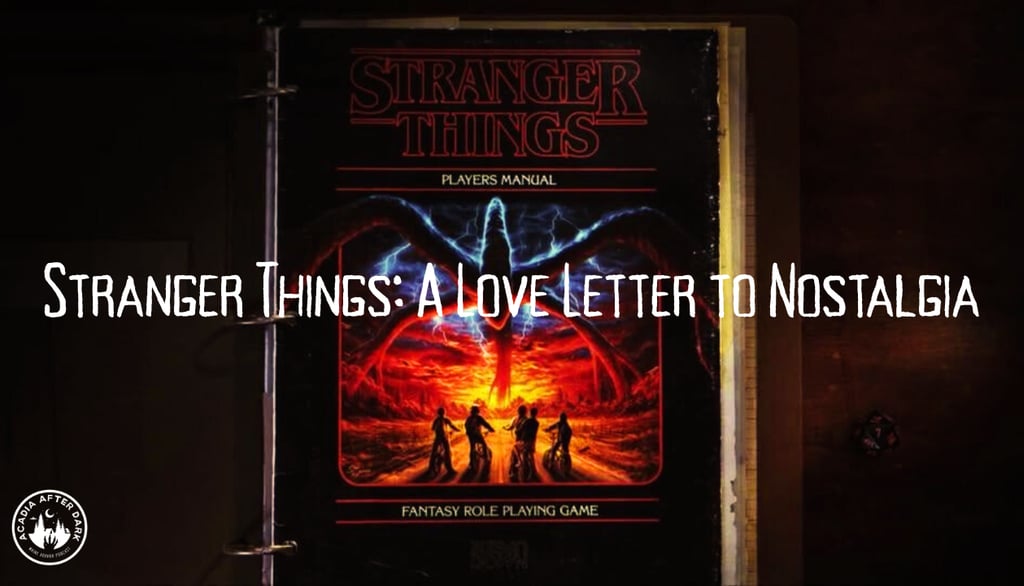

In The Dictionary of Obscure Sorrows, John Koenig coins the term “anemoia,” a nostalgia for a time you’ve never known. It’s the perfect word for what washed over me as the final shots of Stranger Things season 5 faded from the screen. Watching those last moments with a cast and crew we’ve grown up alongside for nearly a decade felt strangely intimate — a goodbye to people who were never really ours, yet somehow were.
Love it or hate it, the show defined a generation. Over its run on Netflix, it drew in millions and reshaped not only the landscape of entertainment but the way we consume television itself.
I was born in 1987, so I never lived through the era the show lovingly recreates, but its story resonates across age and experience. I’ve seen plenty of disappointment online about aspects of the final season (shocking, I know), and I think much of it stems from misplaced expectations. Those who approached Stranger Things as a horror series may have found moments of eerie delight, but at its core, the show was never about horror.
Stranger Things is a love letter to ’80s sci‑fi, yes — but it’s also something more. Like Stand by Me or The Goonies, it’s a coming‑of‑age tale about friendship and the bonds that shape us. Some flare brightly and fade; others become quiet, steady comforts that take years to forge. As I watched the graduation scene and the closing segments that followed, I felt myself tearing up, thinking about my own life and the way relationships shift over time. The finale gives us four closing vignettes, each capturing a different season of our lives, and to me that’s the show’s most essential message.
First, there are the kids — Dustin, Lucas, Mike, and Will — the beating heart of the series from the very beginning. These boys who once gathered in a basement to play Dungeons & Dragons went on to traverse dimensions and face unimaginable dangers, only to find themselves back in that same basement, now made strange by everything they’ve endured.
They say you never forget the friends you made when you were twelve. Childhood friendships feel eternal in the moment, even though they’re often fleeting. Those years are filled with wonder and possibility, a brief window before the world presses in. For the boys in the show, that innocence was stolen abruptly, yet they never lost their sense of whimsy — something beautifully captured in their final D&D game.
Those moments when the party disbands and ends their campaign — what we as viewers assume is their final session — feel like a quiet tribute to the friendships of our own youth. One day, without realizing it, we put that book back on the shelf and never open it again. Yet we remember it fondly, because those early bonds helped shape who we eventually became.
That leads us into the rooftop scene with Robin, Steve, Nancy, and Jonathan — a moment that hits especially close to home for many of us millennials. Watching the four of them gather on the roof of the radio station, sharing beers and memories, reminded me of nights in my twenties with friends who felt like family. Those were years full of chaos and growth, heartbreak and self‑discovery. And then, almost without noticing, you look back at what’s already passed and ahead at what’s still possible, and you realize: not everything worked out the way you imagined, but you’re still here, and there’s still so much life left to live.
Sure, Nancy and Jonathan didn’t work out. But Nancy is clearly headed toward something remarkable. Jonathan’s film might end up winning awards. Steve has a new job and a new sense of purpose. And Robin — Robin will carve out an extraordinary life wherever she lands. There’s optimism in that scene, but also the first sting of nostalgia.
Because one day you’re on that rooftop promising you’ll all meet up next month. And you mean it — for a while, you even follow through. But then life happens. You get a job. You travel. You have kids. And before long, the people who once meant everything to you haven’t texted in years. There’s no dramatic ending. Life just moves forward, and we move with it, trying to keep pace. One morning you wake up and realize they’re simply not there anymore. You think about reaching out, maybe even type the message, but never hit send. You bump into them at the store and say, “We should get together sometime!” but both of you know you won’t.
It’s anticlimactic, and that’s exactly what makes it bittersweet. You don’t notice the moment slipping away — not until long after it’s gone.
Next we come to Joyce and Hopper. Two people who have endured more than their share of hardship, yet somehow found each other — and through each other, a chance at something new. Throughout the series, we’ve watched them grow despite being dealt some of life’s harshest cards.
By season 5, they’ve reached a point where they feel like there isn’t much left to experience. That sense of stagnation shapes their final‑season arcs: Joyce wrestling with the fear that she’s stuck in the past and unable to grow alongside the people she loves, and Hopper believing that if he has nothing left to offer, maybe the kindest thing he can do is disappear.
Only when Joyce and Hopper finally let go of their pasts were they able to find resolution — and, eventually, happiness — together. Their relationship feels like the stage of life I’m in now. Maybe there are more miles behind me than ahead, but in the present I have the tools, the perspective, and the gratitude to make the most of the relationships I still have. The love between Joyce and Hopper isn’t the spark‑and‑fire of young romance; it’s a diamond forged under years of pressure, something resilient and quietly beautiful. As we age and time becomes scarce, our circles shrink. We invest less in building new connections and more in tending the ones that matter, the ones worthy of our limited attention, energy, and heart.
Finally there’s the youngest generation — Derek, Holly, and the other kids who have just survived something traumatic enough to bind them together. Their relationships have been shaped by crisis, but they’ve also been given the gift of time: years ahead to grow, to learn, to understand what these bonds will mean. This may be their first campaign, and who knows what adventures await them. That spark of new friendship is what Mike sees when he looks down from the top of the stairs. In that moment, he recognizes a piece of himself in each of those kids — and I think many of us do too.
And then there’s one more relationship I saved for last: Eleven. She is arguably the emotional center of Stranger Things, yet in the final moments we aren’t given certainty. Instead, we’re asked to “believe.” From the very beginning, El was learning what it meant to have relationships — to be loved, to belong. We watched childhood friendships form and others fade, but hers is the only story that ends abruptly. It’s a quiet, devastating acknowledgment of one of life’s hardest truths: the friends who don’t make it.
Would Eleven and Mike have run away together? Could she have found a safe place far from the military’s reach? Maybe Hopper would have adopted her, and she would have gone to college, built a life, found peace after a childhood defined by suffering.
Like so many others, I’ve known what it is to lose someone far too soon. It’s a wound that never fully heals. There is grief, of course, but the hardest part is the absence of possibility — the life they never got to live. Would they have become a doctor? An artist? Would they have traveled the world? Fallen in love? Would they have been happy?
By ending the campaign the way he did, Mike gave his friends a kind of closure that real life rarely offers. He gave them hope. And in doing so, he showed just how much he’s grown — how deeply he’s learned what it means to be a friend.
Eleven was not simply a friend though. The Duffer Brothers have went on record stating that there “is no version of the story where El is hanging out with everyone at the end” and as sad as that is it is with good reason. In order for Mike and the others to move on and live their lives she needed to be left in the past much in the same way our childish sense of wonder and imagination fades away as we grow into adults. Eleven was the literal embodiment of the magic of being kids.
In the end the one uniting theme which tied all of these different aspects of life and human relationships is the act of overcoming loneliness. Not one of the characters would have made it to the finale without the others and when Vecna’s true nature was revealed it was his choice to isolate and refuse help from the ones who sought to understand him that doomed him.
"The Right-side Up" was a worthy conclusion to a story that while based in a small town and grounded in relatable characters could only be described as epic. Some say that the creators pulled their punches by not having more characters die in the finale. I personally disagree. I feel that while the shock of character deaths would generate clicks on social media and elicit a reaction from the audience, leaving things open ended is more satisfying. It’s a difference of “I can’t believe they killed off…” and "I wonder what happens next?” Only one of these will keep me thinking about the show for years to come.
As I said in the beginning, much like other movies of this genre made in the 80s, Stranger Things leaves the viewer looking ahead as it leaves its protagonists. Rather than looking backwards to “the good old days” or some golden era of the past, it casts eyes on the horizon and looks towards something bigger—a better tomorrow—which is something I think I needed after all these years.
In the end, that’s what Stranger Things leaves us with: not answers, not certainty, but a reminder of what it means to live a life surrounded by people who shape us, challenge us, and sometimes leave us far too soon. The show was never really about monsters or mysteries. It was about the fragile, fleeting, extraordinary connections we make along the way — the friendships that define our childhood, the bonds that carry us through our twenties, the loves that endure into middle age, and the losses that carve permanent spaces in us.
Each of the finale’s closing moments reflects a different season of being human. The kids in the basement remind us of who we were. The rooftop reminds us of who we hoped to become. Joyce and Hopper show us that even after everything, there is still room for love, for reinvention, for choosing each other. And Eleven — her story reminds us of the people who don’t get the chance to grow old with us, whose futures we carry in our imaginations because they never got to live them.
Maybe that’s why the ending feels so resonant. It doesn’t tie everything up. It doesn’t pretend life works that way. Instead, it asks us to believe — not in magic or superpowers, but in each other. In the idea that the time we had mattered. That the adventures were real. That the love was real. And that even when the campaign ends, the story doesn’t disappear. It lives on in the people we became because of it.
For me, that’s the legacy of Stranger Things. Not the nostalgia for an era I never lived through, but the nostalgia for the people I’ve loved, the ones still here and the ones who aren’t. It’s a reminder to hold close what matters while we still can, to appreciate the chapters we’re in, and to believe — truly believe — that the best parts of our story are worth carrying forward.
© 2024–2026 Acadia After Dark L.L.C. • All rights reserved. Born in the pines and fog of coastal Maine.